

The short version
- The castor fails before anything else, and what fails inside it is the bearing rather than the tread.
- A four-castor trolley doesn't spread its load four ways. Castor manufacturers tell you to divide by three.
- Multi-layer coating exists so the surface still resists rust once the paint is scratched. It isn't about gloss.
- Testing that means anything happens in the field. One programme loaded a trolley with 68 kg and pushed it 300 km over mud and concrete joints.
Two trolleys can photograph so similarly you can't tell them apart, and still differ twofold in how long they last. Almost all of that difference sits where a camera can't reach. This works upward from the floor.
The castor, and what lives inside it
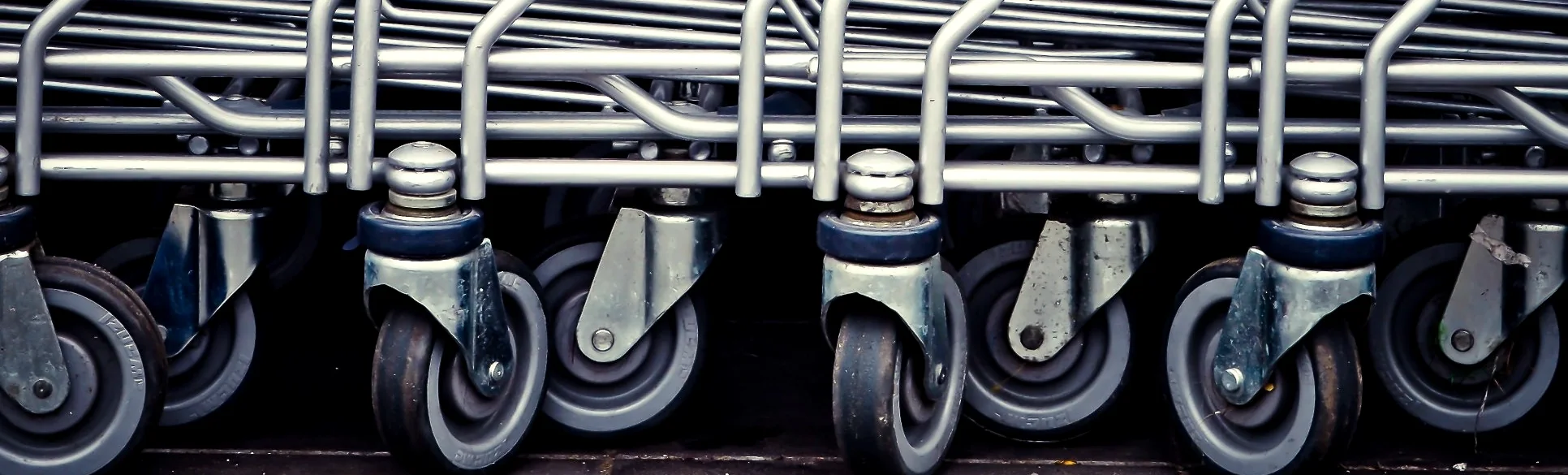
If you only get to look at one component, look at the castor. It takes everything: the load, the impacts, the water, the dust, and the sideways dragging staff do all day.
Plenty of older wheels ran two plain bearings sitting exposed inside the hub. After a while the bearings wear and shift out of position. The person pushing feels it as a shudder, and that's where a trolley stops tracking straight.
Better wheels use a double-row angular contact ball bearing, which takes both radial and axial load, so one of them does the work of two in a slow-turning application like this. How it's assembled matters just as much. Rather than press the bearing into the hub as a loose snap fit, some manufacturers inject the elastomer around it until the two are a single piece. Wheel and bearing can't separate, and there's no gap for water to get in.
One more layer is the plastic double hubcap, keeping water and dust off the bearing directly. In a store that hoses the floor every night, that small part decides how many years the bearing gets.
Tread material: three choices, three drawbacks
| Material | Strength | Drawback seen in service |
|---|---|---|
| Rubber | Quiet, soft, doesn't mark floors | Wears fast when staff drag nested trolleys sideways |
| Hard polyurethane | High wear resistance | Loud on ceramic tile; in one case loud enough to drown out in-store music |
| Cast elastomer | Wear resistance close to PU, much quieter | Costs more to produce |
One manufacturer got to the third option by watching the in-line skate wheels bicycle couriers were using, which ran quietly and still lasted, then trying the same class of material on a trolley wheel.
The load figure people read wrong
The other figure to check is operating temperature. Standard castors run from -20°C to +60°C. If the trolley or dolly has to go into a cold store, the lower-rated version has to be specified at order; retrofitting it later won't work.
Frame tube and welds
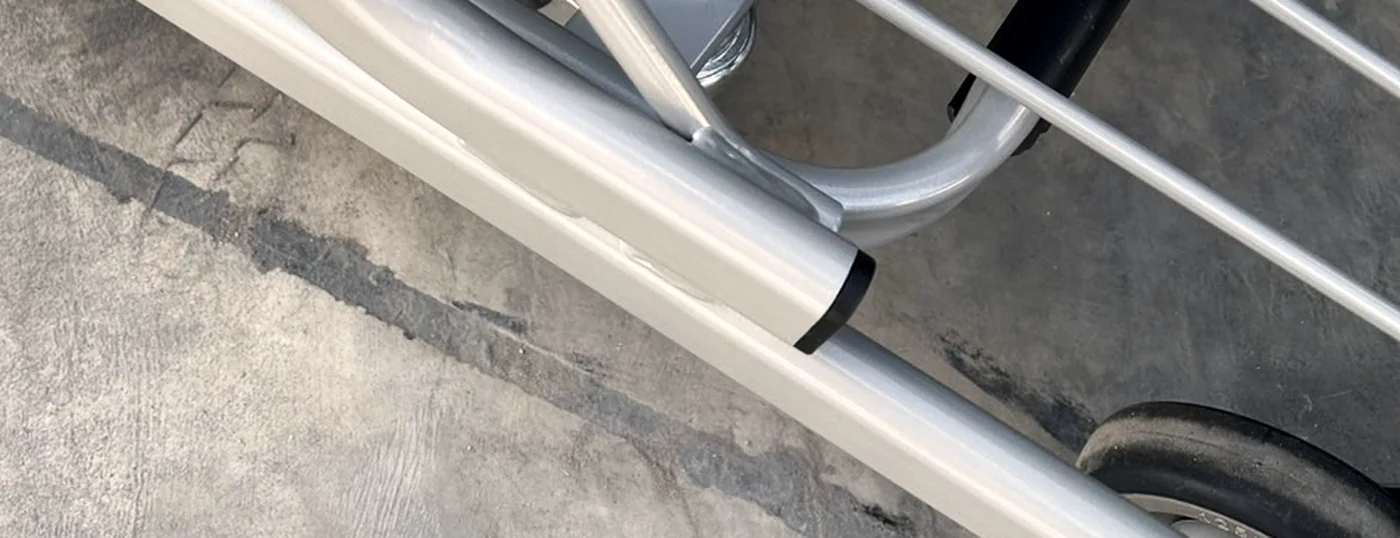
Tube section is engineering rather than styling. A flat-oval section puts stiffness where the load actually sits, compared with a round tube using the same steel, and it lets the trolley be slimmer without giving up strength.
What you can inspect by eye is the weld where the basket meets the frame, and where the frame meets the wheel base. Even, consistent welds against uneven beading tell you more than the catalogue specification does.
The most direct indicator is the guarantee. Wanzl guarantees the stability of welded joints for ten years, which is a structural claim the manufacturer has to stand behind, unlike the word "durable", which nobody is accountable for.
Coating, and why it's layered
Wanzl's main protection system runs in three stages:
- Electrogalvanising — the layer protecting the steel itself.
- Electrodeposition painting — reaches corners and recesses conventional spraying can't.
- Powder coat — the outer layer taking the abrasion and carrying the colour.
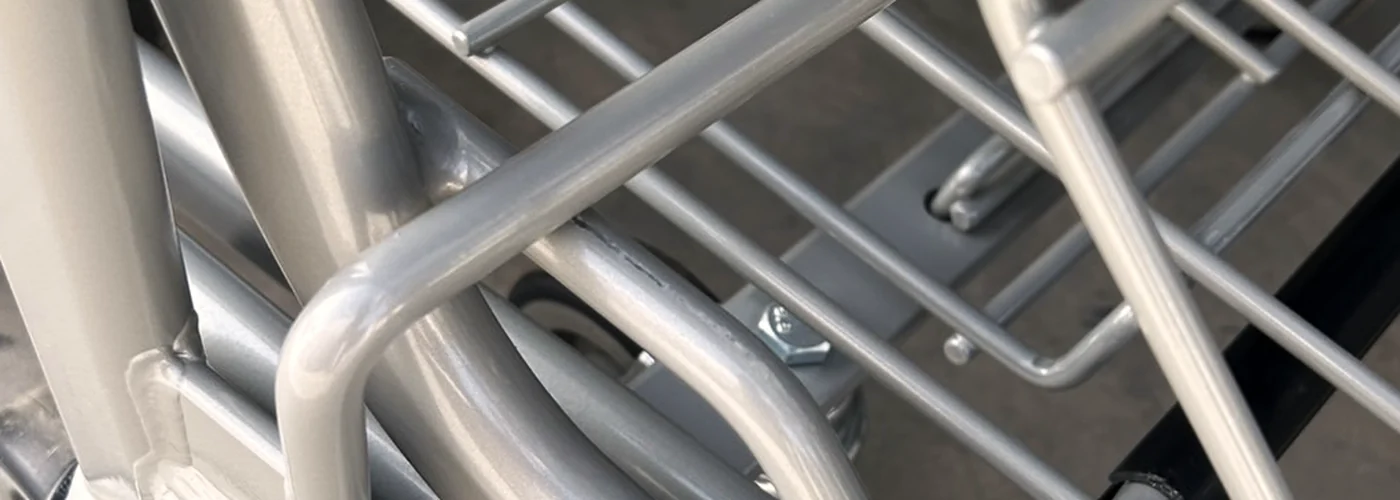
Three layers exist because of the condition the product lives in. A trolley six months into service has scrapes from other trolleys, from shelf ends, from cars in the car park. The layered system is built so the surface still resists red rust once the outer paint is damaged, which is normal rather than exceptional.
The classic alternative is chrome plating over high-gloss zinc, finished with a baked transparent varnish for gloss and corrosion resistance. Plain chrome suits indoor use and handles normal scuffing, but it wasn't built for heavy abuse.
There's a side effect that rarely gets mentioned. A coated surface cuts metal-on-metal noise when trolleys nest and when they roll over uneven ground.
Nesting depth converts straight into metres
Nesting depth is the extra length each trolley adds when nested behind another, and it converts straight into shop floor. 30 trolleys with a 5 cm difference in nesting depth make a row 1.5 metres longer.
What throws it off in practice is wheel wear. In the documented case above, a 12 cm wheel worn to 9 cm stopped the trolley nesting as designed. That's where a wheel problem turns into a floor-plan problem.
Child seats and safety standards
EN 1929 is a multi-part standard. Part 1 covers construction, performance, testing and safety for general basket trolleys, with or without a child-carrying facility. Part 7 covers baby and child carrying facilities specifically.
Part 2 covers trolleys on passenger conveyors, and every requirement in it is measurable: total loaded mass on the conveyor no more than 160 kg, wheels at least 120 mm across, a holding device that keeps the trolley stopped on its own, no overturning on a 16° longitudinal or 10° lateral slope. It also calls for inspection at least every six months.
The Wanzl products ACE SITHA supplies are built to this family of standards. Ask any supplier for paperwork naming which part applies to which model.
What a meaningful test looks like
A trolley wheel development programme illustrates this well. The team found laboratory results didn't reflect field conditions, so they moved the testing outdoors for three months.
When a supplier says a product has been tested, the follow-up is what the test actually was: what load, what distance, over what surface.
Five checks you can run in two minutes
With a sample trolley in front of you, these five take under two minutes and tell you most of what you need.
What to do with a sample trolley
- Push it one-handed in a straight line for 10 m. A good one tracks straight with no correction. If you're pulling it back, the castors or bearings are already wrong and it's still new.
- Lift one corner and set it down. A properly welded frame won't rock.
- Spin each castor by hand and listen. All four should turn smoothly and equally quietly. Grinding on a sample means the bearing isn't sealed.
- Nest two and pull them apart. They should go in and come out without force, and the baskets shouldn't foul each other.
- Look at the weld where the basket meets the frame. You want consistency, not neatness.
Checks one and three rule out the most candidates. A trolley that won't track straight before anyone has used it isn't going to improve on its own.