


The short version
- EN 1929-2 calls for trolleys and their holding devices to be inspected at least every six months. In practice almost nobody does it once handover is signed.
- The castor always needs replacing first, and it costs a fraction of a trolley.
- You can find a bearing that's about to fail by hand in ten seconds, before the trolley strands itself mid-aisle.
- A trolley whose worn wheels stop it nesting costs you floor space every day, even while it still rolls.
A normally maintained trolley lasts around ten years. The word "maintained" in that sentence is doing a great deal more work than most people assume.
The requirement everyone drops after handover
EN 1929-2, which covers trolleys used on passenger conveyors, asks for inspection and operating tests at three points: at delivery, after any major modification, and at least every six months.
The inspection covers the trolleys themselves, the holding devices, whether laden and unladen trolleys can enter and leave the conveyor, and how the holding devices behave when an emergency stop goes off.
The first one usually happens. So does the second. The third almost never gets touched, and it's the only one that comes round again across the whole service life.
A schedule that survives a real store
This runs on the staff already there. No specialist, no downtime.
| Frequency | What happens | Time |
|---|---|---|
| Weekly | Take 10 trolleys at random from the line, push each one-handed for 10 m, pull out any that won't track | 10 minutes |
| Monthly | Check every child seat: straps, catches, hinges | Depends on fleet |
| Every 6 months | Full fleet, the checklist below, recorded in writing | Half a day per 100 trolleys |
| Annually | Physical count against the register — how many are gone, and from where | 1 day |
The weekly sample is the best value on that list. It catches trolleys that are starting to go before a customer meets one, and it takes so little time there's no excuse for skipping it.
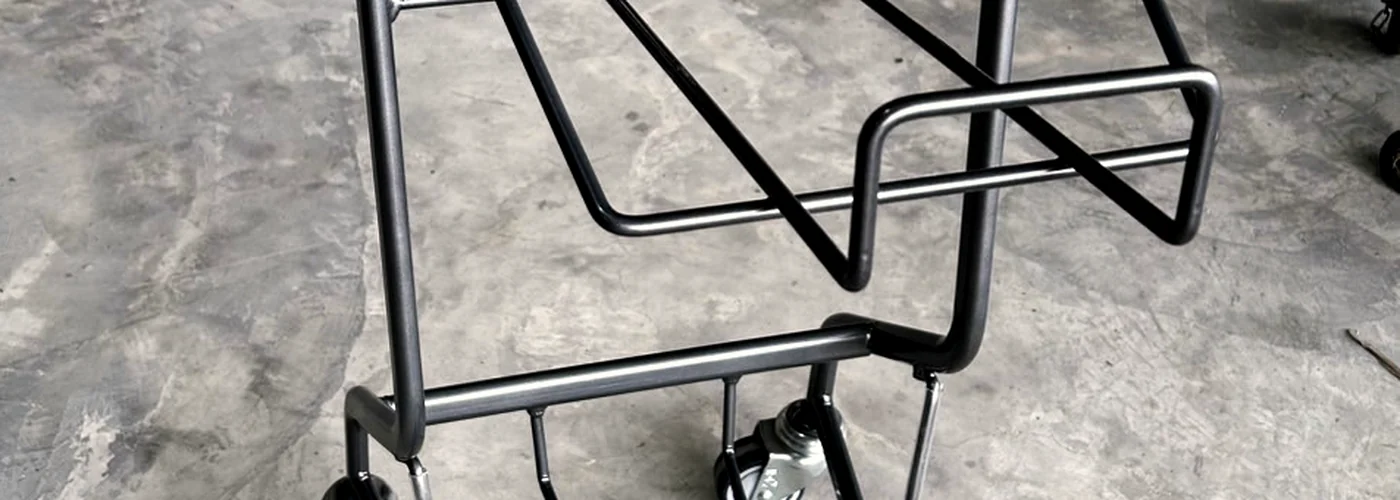
The six-monthly checklist
Eight checks per trolley
- Spin all four castors by hand and listen. They should turn smoothly and equally quietly. Grinding or drag means water has got to the bearing.
- Measure wheel diameter against a new one. More than about a quarter worn and nesting depth starts to drift.
- Push one-handed for 10 m. If it needs correcting, note which castor.
- Lift a corner and set it down. Rocking means the welds or mounting points are fatiguing.
- Inspect the weld where the basket meets the frame. Look for cracking, and for rust coming up from under the paint.
- Child seat — straps, catches, hinges, seat panel. Replace on suspicion; don't wait for the next cycle.
- Coating. Red rust means the layers are breached to bare steel. Record where it keeps appearing.
- Nest it against a neighbour. If it won't seat properly, or needs force, look at the castors first.
Record it as a simple row per trolley: number, date, result of each check, what was done. That record answers the question if there's ever an incident, and it turns repair-or-replace from an opinion into a decision with evidence behind it.
Repair or replace
The usable test is to weigh the repair against what's left of that trolley's service life.
Almost always repair when the problem is a castor, a handle, a child seat or a coin lock. These are designed to be changed and cost a fraction of the whole unit. If the trolleys you bought won't take replacement castors individually, that's useful information for the next order.
Replace the unit when the problem is structural: cracked welds, a twisted frame, or rust into the steel in several places. On-site weld repairs don't restore the original strength and nobody will stand behind the result.
The dividing line is whether the part was designed to be replaced. Castors were. Frames weren't.
Three numbers worth knowing about your own fleet
If nobody has ever counted them, they're worth the day it takes.
- Actual count against the register. The difference is what's gone, and it's usually bigger than expected.
- How many are unusable right now. Trolleys parked behind the store because they won't push are still assets on the books and are producing nothing.
- Which branches lose the most. Published retail data suggests a quarter of sites can account for over seventy percent of losses. If yours behaves the same way, that's where the money belongs.
These three turn the budget conversation from impressions into facts, and they usually show that repairing the existing fleet comes in well under the cost of adding to it.
If you bought them somewhere else
The schedule and the checklist above work on any make. Nothing in them is specific to what we supply.
The one limit you'll hit is parts. If the trolleys in service won't take replacement castors, or no spares are held in the country, the options narrow to running them until they fail or replacing them outright. Worth asking a supplier before buying rather than once the wheels start to wear.
ACE SITHA will survey a trolley fleet and report against this checklist, including trolleys we didn't supply. Send the number of units and sites and we'll tell you how long it takes and what needs preparing.